The free spaced repetition app that remembers everything you learn.
Recall is your calm second brain. Paste a link, PDF, markdown note, or code snippet — the FSRS algorithm schedules the perfect moment to see it again. Optional AI generates flashcards and grades your answers. Capture in under 10 seconds, review in under 30. The friction-free Anki alternative.
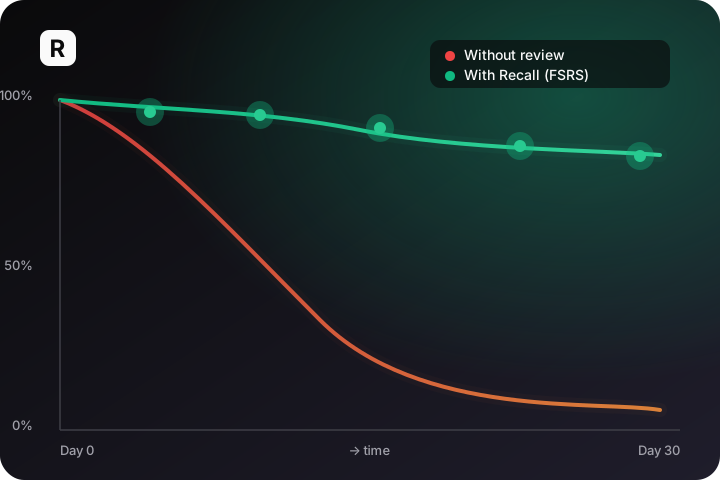
The Ebbinghaus forgetting curve flattened by spaced reviews.
Features
Capture anything in 10 seconds
Paste a link, PDF URL, markdown note, or code snippet. Recall auto-detects the type, fetches an OpenGraph preview for links, extracts text from PDFs, and turns it into a reviewable card. PWA share target so anything on your phone is one tap away.
Keywords: save links to remember, PDF flashcards, markdown notes, code snippet memorization
Reviews scheduled by FSRS
The Free Spaced Repetition Scheduler is the modern algorithm that outperforms SuperMemo's SM-2. Recall persists your individual forgetting curve, so the next review lands exactly when you'd otherwise forget.
Flip, type, recall + reveal, or AI quiz. Keyboard-first: space to reveal, 1–4 to rate Again / Hard / Good / Easy. Interleave-by-tag boosts retention versus blocked practice.
Keywords: active recall, flashcards app, free flashcards, study app, interleaving practice
Optional AI assist
Bring your own Anthropic Claude API key. On save, Recall generates a one-line summary, 3-5 key concepts, and 3 flashcard Q&A. During review, AI quiz grades your typed answers and suggests a rating.
Keywords: AI flashcards, Claude flashcards, AI quiz generator, automatic flashcard creation
Stay reminded, never spammed
Daily 8am email digest via Resend and quiet web push (VAPID) — only when something is due. One-tap unsubscribe. GitHub-style heatmap, streak counter, 30-day load forecast.
Runs on Vercel Hobby + Neon Postgres + Clerk + Resend. Every service is free at the tier we use. Your data, your keys, exportable to JSON and Anki. MIT licensed.
Keywords: self-hosted Anki alternative, free Anki alternative, open source flashcards, Next.js learning app
How spaced repetition with FSRS works
Hermann Ebbinghaus showed in 1885 that we forget about 50% of new information within an hour and ~80% within a week — unless we actively review it. Spaced repetition flips this: by scheduling reviews right before you would forget, every repetition costs less and lasts longer. FSRS (Free Spaced Repetition Scheduler) is the modern open algorithm that models your individual memory stability and difficulty per card and computes the next review interval that maximizes retention while minimizing time spent. Recall is built on the ts-fsrs reference implementation.
1
Capture. Paste a URL, PDF link, markdown, or code. Recall auto-detects type and fetches a preview.
2
Review. FSRS picks the next due date. You rate Again / Hard / Good / Easy. The algorithm learns your curve.
3
Retain. Reviews stretch from days to weeks to months as stability grows. You keep what you learned, forever.
Frequently asked questions
What is spaced repetition?
Spaced repetition is a learning technique that schedules each review at the moment you're about to forget the material. Done right, it converts short-term recognition into permanent recall with the minimum number of repetitions. Recall implements spaced repetition using FSRS, the most accurate open scheduler available today.
How is Recall different from Anki?
Anki is excellent but has friction: you have to format each card front/back, the desktop UI is dated, and modern sync requires a paid AnkiWeb account or self-hosting. Recall accepts any input (link, PDF, markdown, code) without forcing a card format, ships a clean PWA, uses FSRS instead of SM-2, optionally generates flashcards with Claude AI, and is fully self-hostable on free tiers.
Is Recall free?
Yes. Recall is open source (MIT) and the hosted reference deployment is free. All third-party services we depend on (Vercel Hobby, Neon Postgres, Clerk, Resend) have generous free tiers that Recall stays within by design.
What is FSRS?
FSRS (Free Spaced Repetition Scheduler) is a modern, open-source spaced repetition algorithm. It models your individual memory stability and difficulty per card and computes the next review interval that maximizes long-term retention while minimizing review time. It outperforms SuperMemo's SM-2 — the algorithm that classic Anki uses by default — in benchmarks.
Can I import from Anki?
Recall exports to a tab-separated format Anki Desktop imports natively (File → Import → Text). Anki → Recall import is on the roadmap. In the meantime, paste a list of URLs or notes in the Settings → Import box to bulk-add.
Do I need an API key for AI features?
Only if you want AI summaries, AI-generated flashcards, or AI quiz grading. Provide your own Anthropic Claude key in Settings — it's encrypted with AES-256-GCM at rest and used only when you enable AI on an individual item. The rest of the app works perfectly without it.
Does Recall work offline?
The review queue is cached by a service worker, so once today's session is loaded you can keep reviewing on a flight or subway. Capture and stats require network.
Is my data private?
Yes. All your items live in your own Postgres database. The app is open source so you can audit exactly what runs. Your Anthropic API key is encrypted at rest. If you want full ownership, self-host — the README has a 7-step Vercel deploy walkthrough.
Who Recall is for
📚 Students preparing for exams (USMLE, bar, GRE, finals)
👩💻 Engineers learning new languages, frameworks, syscalls
🧠 Knowledge workers who read 100+ articles a month
🌍 Language learners (vocab + grammar)
🎓 PhD researchers tracking concepts across papers
🧑⚕️ Medical residents, paralegals, anyone with high-stakes recall